Kjell Karlsson

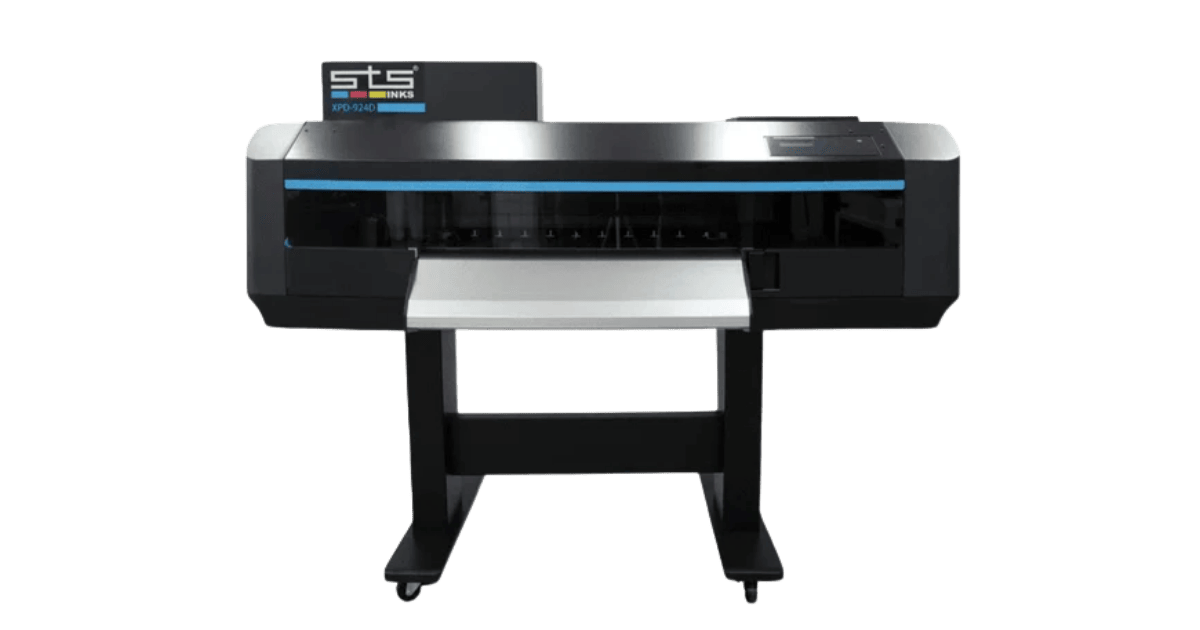
Our STS XPD-724 review covers real-world specs, pros & cons, inks, workflow, costs, and setup tips—so you can decide if this 24″ DTF fits your production.
STS XPD-724 Review (Direct-to-Film Printer)

📋 Key Specifications — STS XPD-724
| Manufacturer | STS Inks |
| Print Method | Drop-on-Demand piezo (variable dot 3.5 pl) |
| Max Resolution | Up to 1440 dpi |
| Print Modes | 720/540/360 dpi (12+ modes) |
| Colors | CMYK + 2×White (plus 2 cleaning channels) |
| White Ink Handling | Built-in circulation |
| Max Media / Print Width | 24.8″ media / 24.4″ printable |
| Heating | Pre / Post heaters |
| Quoted Speed | Up to ~30 ft²/hr (mode-dependent) |
| Roll Handling | Auto cut; 2″/3″ cores (varies by package) |
| Recommended Inks | STS DTF (220 ml cartridges; CMYK + White) |
| Included Software | Varies by reseller (e.g., RIP license) |
| Standout Features | White-ink circulation, upgraded waveform for reduced graininess, G7 ICC profiles |
Specs compiled from STS’s official product page and reseller listings.
The XPD-724 balances print quality and uptime in a small footprint. Variable-dot 3.5 pl, reliable white circulation, and pre/post heat make clean edges and consistent opacity achievable with mainstream PET films.
🔍 Performance Analysis — STS XPD-724 review
At up to 1440 dpi with variable-dot 3.5 pl, the STS XPD-724 renders smooth gradients and sharp micro-type on standard PET DTF films. White circulation helps keep the channel active, reducing purges and dropouts on long gang sheets. Pre/post heating stabilizes laydown and helps powder adhesion—especially useful on dense whites across dark garment work.
🔗 Connectivity, RIP & Workflow — STS XPD-724 review
Exact RIP bundles vary by dealer, but the platform is commonly paired with a modern DTF-aware RIP that handles mirror/white logic, hot folders, and queues. Build named film presets and standardize heater targets per SKU to keep color and hand-feel consistent across shifts. Daily habits matter: rotate/prime whites, run a quick nozzle check, and keep RH 40–60% to reduce waste.
💰 Running Costs & Uptime — STS XPD-724 review
Like all DTF, white coverage dominates cost. The XPD-724’s circulation plus smaller 220 ml cartridges make topping up easy without committing to bulk tanks. Track ink/film use by SKU in the RIP to dial in cost-per-print. Reseller claims around ~30 ft²/hr are mode-dependent—optimize passes vs. coverage to hit your quality/throughput target.
🎯 Who Should Buy It? — STS XPD-724 review
Choose the XPD-724 if you want a manageable 24″ line with stable whites and predictable upkeep. It’s a strong fit for small apparel shops and on-demand producers who need reliable gang-sheet output without a 30–63″ footprint. If your queue is heavy 24/7, step up to dual-head or wider systems; if budget is paramount, verify what’s bundled (RIP, training, shaker) to avoid hidden costs.
Explore more: see DTF Printers by Size for alternatives.
❓ FAQs — STS XPD-724 review
What’s the maximum printable width?
Up to 24.4″ printable on 24.8″ media.
How fast is it?
Resellers quote up to ~30 ft²/hr; actual speed depends on resolution/passes and artwork coverage.
Which inks does it use?
STS DTF cartridges (CMYK + White), typically 220 ml; STS promotes degassed/encapsulated pigments and white circulation stability.