Kjell Karlsson

Our RICOH Pro D1600 review focuses on real-world specs, print speed, film widths, uptime features, and who should buy this integrated, powder-and-drying DTF system.
RICOH Pro D1600 Review (Industrial 1.3 m / 51″ DTF System)

📋 Key Specifications — RICOH Pro D1600
| Manufacturer | Ricoh |
| Printheads | RICOH MH5441 / GEN5 class, 3 heads (color-color-white staggered). |
| Inks | Ricoh Pro™ DTF Ink (water-based pigment) CMYK + White; high white opacity, high-speed jetting. |
| Max Print Width | 1,300 mm (51″) roll width (dealer technical sheet). |
| Media Support (system) | Ricoh states film support up to 1,600 mm in announcements. |
| Resolution | Up to 1200 dpi. |
| Productivity | 20.2 m²/h (600×600 dpi, 8 pass); 13.6 m²/h (600×900 dpi, 12 pass). |
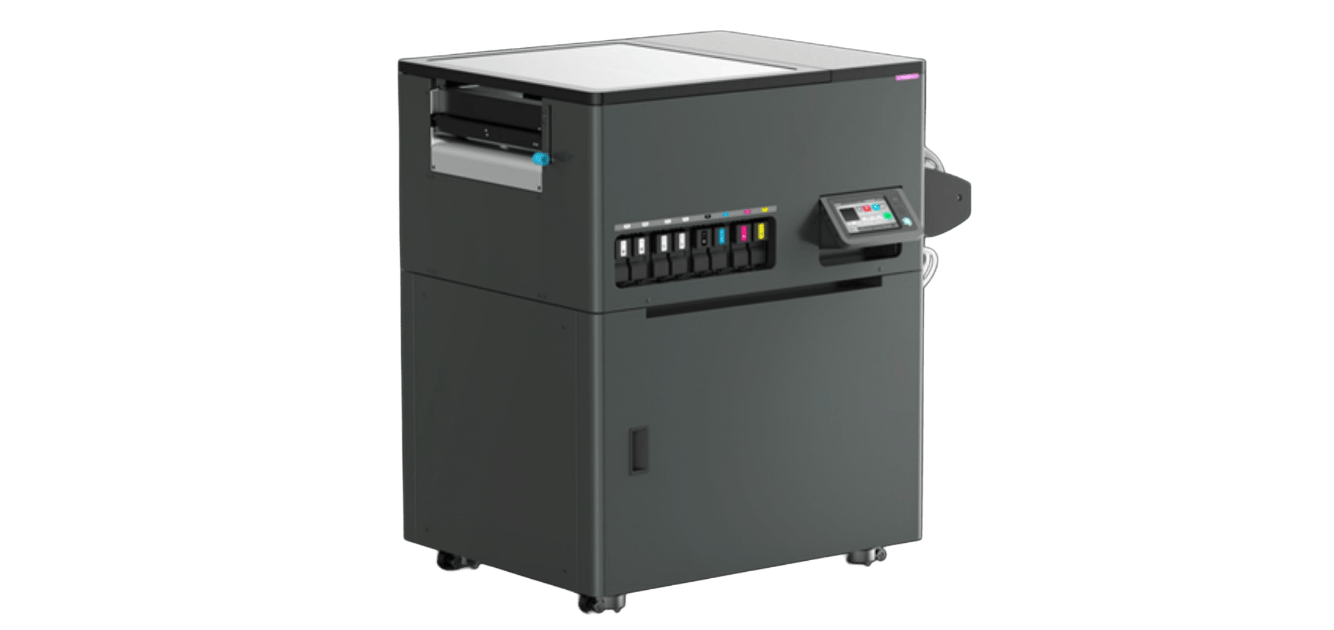
| Integrated Line | Built-in powder application & drying. |
| RIP / Guides | Ricoh RIP settings & operating instructions available via support site. |
| Power | AC 208–240 V, 16 A (spec sheet). |
Why 1.6 m vs 1.3 m? Ricoh press/info mention up to 1.6 m films, while multiple dealers list 1.3 m print width. We treat 1.3 m as the safe, job-planning width and 1.6 m as overall system capability.
The Pro D1600 blends industrial heads, 20 m²/h-class throughput, and an in-line shaker/dryer to minimize handoffs and banding risk. Best for shops moving past 24–35″ desktop DTF into consistent, shift-length output.
✅ Reasons to Buy
- 20+ m²/h class output for steady gang-sheet production.
- 3× Ricoh GEN5/MH5441 heads with CMYK + high-opacity white.
- Integrated shaker & dryer reduces touchpoints and variability.
- Backed by Ricoh service, docs, and RIP guides.
❌ Reasons to Avoid
- Footprint and power needs exceed desktop DTF lines.
- Width messaging varies (1.3 m print vs up to 1.6 m film). Align expectations with your dealer.
🔍 Performance Analysis — RICOH Pro D1600 review
At 600×600, 8-pass, dealer data shows ~20.2 m²/h; at 600×900, 12-pass it’s ~13.6 m²/h. That’s real industrial territory for on-demand tees and e-commerce. Pair with approved 120–128 cm films for stable laydown and consistent peel.
🔗 Workflow, RIP & Materials — RICOH Pro D1600 review
Ricoh’s docs and RIP guides (ColorGATE & others support the platform) simplify onboarding; keep recipes per film SKUs and white ink coverage. The integrated shaker/dryer keeps output moving in-line and reduces over- or under-powdered sheets.
💰 Running Costs & Uptime — RICOH Pro D1600 review
High-opacity white is the cost lever. The Pro D1600’s industrial headset and Ricoh DTF ink are tuned for high-speed jetting—fewer recovery cycles and better yield when humidity is kept 40–60% RH. Log ink/film per job to expose true COGS.
🎯 Who Should Buy It? — RICOH Pro D1600 review
Choose the Pro D1600 if you’ve outgrown 24–35″ DTF or are migrating from DTG and need shift-length, integrated production with predictable quality. If your work is sporadic or mostly small logos, a mid-width DTF may be more economical.
❓ FAQs — RICOH Pro D1600 review
What is the actual width?
Ricoh press says film support up to 1,600 mm, while multiple dealer datasheets list 1,300 mm max print width. Confirm with your reseller for your configuration.
How fast is it?
Dealer technical data cites ~20.2 m²/h in 600×600/8-pass and ~13.6 m²/h in 600×900/12-pass modes.
Does it include powder & curing?
Yes—integrated powder application and drying system, designed for continuous production.
What heads and ink are used?
Three Ricoh industrial heads drive CMYK + White with Ricoh Pro DTF Ink for high white opacity and stable, high-speed jetting.
📌 Sources
Official page: RICOH Pro™ D1600 — specs/news: Ricoh EU, Ricoh Support.
Accessed: 16 Oct 2025